
India's Internet economy has two choices: An immediate $30 billion Sale-and-Leaseback or a $3 trillion value harvesting over decades, observes Vibhu Arya.

While two-wheeler sales are down 15 per cent year-on-year, passenger vehicles sales are lower by 5-7 per cent.

The operating margin of India Inc is likely to drop in the December quarter with a 100-120 bps year-on-year decline, as 27/40 sectors are set to see crimped margins despite higher revenue, according to a report. Surging commodity prices and price hikes may help companies report a healthy 16-17 per cent revenue growth to Rs 9.1 lakh crore during the quarter ending December, the Crisil report said on Tuesday. Software major TCS will open the earnings season Wednesday.

This number is more than the total number (1,071) of electric cars sold in India in calendar year 2019. MG has stopped registrations for the ZS and will cater to 2,409 of the total bookings.

Modi, upon arrival, was received by External Affairs Minister Sushma Swaraj.

So far, there seems to be limited debate about their activities in India, where virtually all FAANG companies have teamed up in different ways with India's most powerful businessman, observes T N Ninan.

Though the intent has been hailed as good for the economy, teething problems remain with a five-rate structure for various goods and services

Google is going ahead with a policy revision mandating 30% charge on in-app purchases across all apps on Play Store. This has left developers' community worried about tighter squeeze on their earnings, says Yuvraj Malik.

The GST Council's agenda includes trimming the number of items in the 28 per cent slab by 75 per cent, easier compliance for assessees and small taxpayers, and a presentation on bringing real estate under GST.
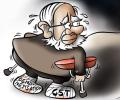
While GST and insolvency laws are among the major achievements of the Modi government, the list of failures include demonetisation, toxic banks, manufacturing hiccups and most prominently bizarre job creation figures. Mihir S Sharma takes a look at the four years of Modi government.

Growth numbers for the large players in the sector, though, improved during the quarter.

Overall, the populist/ electoral elements in the budget have remained measured with the finance minister being clearly aware of a higher-than-expected rise in oil prices, less-than-planned tax revenues and the wider deficit for FY 17/18, constraining his margin of maneuver, says Claude Claude Smadja.

Increase of 10% to 12% likely in a bid to improve citizens' mood after demonetisation.

This year, the government made quoting of Aadhaar mandatory for filing income tax returns as well as obtaining a new PAN.

The investment will be made through a joint venture with Toshiba and Denso. The battery is the most expensive single part of an EV.

The government, in February, had released the draft national e-commerce policy proposing setting up a legal and technological framework for restrictions on cross-border data flow and also laid out conditions for businesses regarding collection or processing of sensitive data locally and storing it abroad.

Mukesh Ambani-owned RIL's JioMart is set to launch a slew of new products including financial services, electronics to airline tickets to take on the competition from upcoming rivals like the Tata Super app and other established players including PayTM, Amazon and Flipkart. This comes at a time when RIL's e-commerce revenues are set to grow by 35 per cent to $15 billion within four years and its core retail revenue is expected to grow at the same pace to $44 billion, as per a forecast by Goldman Sachs. "The Tata vs JioMart war will be the next big corporate battle to watch. "While Tata has an upper hand like in-house products and brands, RIL has the backing of global biggies like Google, Facebook and Microsoft," said head of a rating firm asking not to be quoted.

The GST rate on mobile phones will be hiked to 18 per cent while that on maintenance repair overhaul (MRO) services for aircraft will be lowered to 5 per cent with effect from April 1, Finance Minister Nirmala Sitharaman said on Saturday. The GST rate on handmade and machine-made matchsticks has been rationalised to 12 per cent from 5 per cent and 18 per cent respectively.

The government has unleashed a slew of reforms to attract greater investments including higher foreign direct investment in defence and opening up the railways infrastructure sector, relaxed labour laws, launched campaigns like the Make in India for re-invigorating manufacturing, Clean India and Digital India, among others.

The first half of 2019-20 will be under pressure, since prices are expected to go up by Rs 7,000-8,000 at a time when sentiment is poor.

The 70 launches were made in the first half of the financial year alone and were mostly focused on hygiene, health & wellness, naturals and convenience, which were in high demand as Covid -19 raged across the world.

In DigiLocker, a user can get different government departments to issue documents in digital format. At present, there are 117 such issuers. You can get PAN, Aadhaar, vehicle fitness certificate, vehicle tax receipt, class ten and twelve mark sheets, driving licence, caste certificate, ration card, birth certificate, college degrees and diplomas, marriage certificate, and many more.

Omkeshwar Singh, head, Rank MF, a mutual fund investment platform, answers your queries.

He noted that the Rupee has firmed recently but cautioned that the currency should not lose its competitiveness in global trade.

In 2020 a round of hikes in customs duty on components like compressors, motors and printed circuit boards aggravated the situation, coronavirus crisis is now leaving manufacturers with no option but to hike prices despite fall in sales.

Nilekani said new-age technology markets work on a winner-takes-all basis.

For years it has been evident that fibre and DTH would give tough competition to cable in India where regulatory overload has mutilated an already warped industry structure. OTT added fuel to the fire. From Rs 27,000 crore in 2010, cable's share of subscription revenues is now estimated at Rs 13,000 crore.

The Jan-Dhan accounts are zero balance accounts, comes with a life cover of Rs 30,000 per person, and an accidental cover of Rs 100,000. An active user of the account can also get overdraft facility of Rs 5,000 from banks.
More people are now comfortable using their debit cards.

Leveraging global capital markets to give muscle to an innate competitive advantage in rapid mass transaction systems will lead to India becoming a petri dish for global enterprises and new-age innovation that it yearns to be.

'Their vote bank has shifted to the BJP; the Congress is yet to realise it.'

For 2015-16, the planned outlay for the department was Rs 2,568 crore.

'There is a vision in the Budget, and the vision is to take India from a largely agrarian, rural economy into a fast-track digitalised economy.'
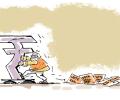
'We have promised to ensure reduced tax rates.'

Tata Consultancy Services (TCS) on Thursday said it plans to invest more than $100 million in Austin and hire 1,000 new employees across Texas. TCS has expanded its business operations in Austin, Texas with the construction of a new facility, doubling its presence to more than 400 professionals in the city and adding to its over 5,500 employees across the state, TCS said in a statement. The new facility will officially open in late December 2020 and have space for 367 employees, it added.

Credible fiscal consolidation has been a consistent pre-condition to easing the monetary policy stance as far as the RBI is concerned.
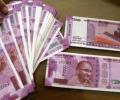
"Cash is still quite high in the system. There is also stocking of Rs 2,000 notes in evidence. The expansion of digital payments is taking place all over the world. It is happening in India as well. The pace is much slower," S C Garg, who took VRS from government service after he was abruptly shifted out of the finance ministry, said in a note.

As part of this strategy, the e-commerce major has launched a programme to manage the entire business-to-business inventory supply and management for kirana stores in three cities in Karnataka.

Omkeshwar Singh, head, Rank MF, a mutual fund investment platform, answers your queries.

With the rise in interest rates, bond yields have been on the rise; this will dent banks' treasury profits. Also, many retail borrowers may find it difficult to service their loans when the loan rates rise, points out Tamal Bandyopadhyay.
 © 2026 Rediff.com - Advertise with us - Disclaimer - Privacy Policy - Sitemap - Feedback - About us - Terms of use - Grievances